
成果速递:IOM实验室提出一种用于预测消费者购买意愿的序贯可解释深度学习方法
Title: Next, browse or purchase—A sequential and interpretable deep learning approach for predicting customer purchase intention
Authors: Feng Jiahui; Liu Hefu
Journal: Information Sciences
URL: doi.org/10.1016/j.ins.2026.123144
abstract:
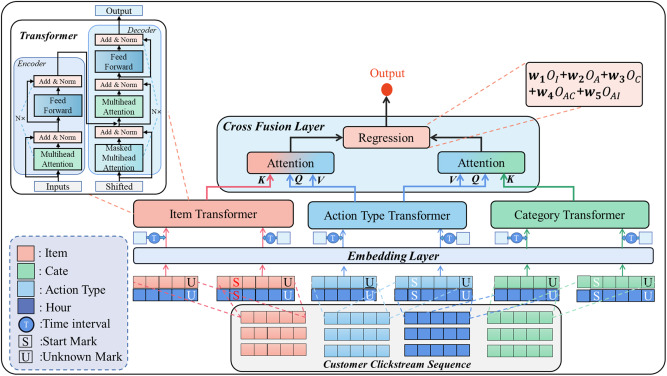
E-commerce platforms often face the challenge of high user traffic accompanied by low purchase conversion rates, making the real-time identification of consumers with strong purchase intentions a critical problem. User browsing behavior provides valuable signals for such real-time prediction. However, most existing studies primarily rely on discrete click features or single-attribute click sequences, thereby failing to fully capture the inherently sequential and multi-attribute nature of customer behavior. Additionally, some studies that adopt deep learning models prioritize predictive accuracy while sacrificing interpretability, which limits their practical adoption by business operators. Therefore, the effective utilization of browsing data presents three key challenges: sequentiality, interactivity, and interpretability. In this study, grounded in cognitive response theory, we propose an interpretable deep learning framework named Multi-Channel transFORMER (Mcformer) to predict customer purchase intentions. Our model employs a multi-channel Transformer to capture real-time customer preferences from multi-attribute clickstream data, while a cross-fusion layer learns the interaction information across different attribute sequences. Experiments conducted on a real-world dataset containing sequences of varying lengths demonstrate the superior effectiveness of Mcformer. Furthermore, we systematically analyze the model’s interpretability from the perspectives of model parameters, input data, and correlation analysis. This enhances the transparency and trustworthiness of Mcformer, facilitating its adoption and further development by business decision-makers. Overall, this study contributes to the literature on customer purchase behavior modeling and offers meaningful insights into the interpretability of deep learning models, with important implications for both theory and practice.