
成果速递:IOM实验室提出一种提高准确性和运营效率的空间和语义建模方法
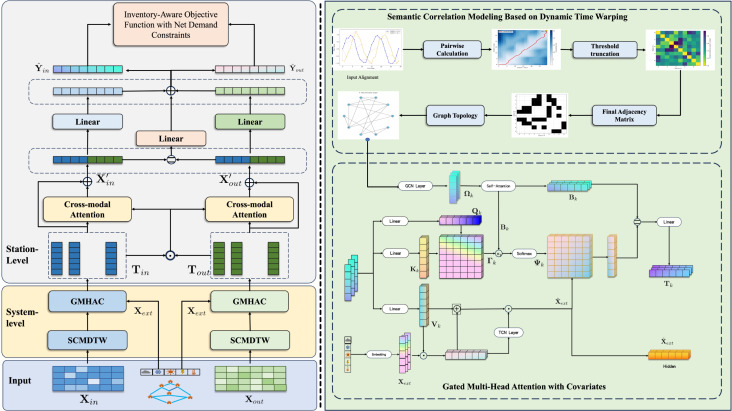
Title: Demand prediction for bike-sharing systems: A spatial and semantic modeling approach for enhanced accuracy and operational efficiency
Authors: Wu Juntao; Feng Jiahui; Fang Jie; Liu Hefu
Journal: Computers & Industrial Engineering
URL: doi.org/10.1016/j.cie.2025.111775
abstract:
The exponential growth of Bike-Sharing Systems (BSS) has introduced complex challenges in supply–demand management, where imbalances frequently lead to resource wastage and reduced user satisfaction. While Graph Neural Networks (GNNs) have become a mainstream tool for demand forecasting, existing methodologies predominantly rely on static geographic proximity, failing to capture the latent semantic dependencies driven by actual riding behaviors. To bridge this gap, this paper proposes a novel Spatial-Semantic Graph Attention Neural Network (SSGAN). Unlike traditional models, SSGAN constructs a semantic adjacency matrix using DTW to quantify the shape similarity between station inflow and outflow patterns, thereby capturing non-Euclidean correlations beyond physical distance. Furthermore, a Gated Multi-Head Attention mechanism is designed to dynamically weigh these semantic relationships by integrating external covariates (e.g., weather), allowing the model to adapt to time-varying contexts. Crucially, to align prediction accuracy with decision effectiveness, the model employs a dual-stream architecture that fuses inflow and outflow features to better reflect net inventory changes. Empirical experiments on large-scale real-world datasets from Citi Bike and Divvy demonstrate that SSGAN not only achieves state-of-the-art prediction accuracy but also significantly reduces operational costs compared to baseline models. This study provides a generalized, decision-oriented computerized methodology for optimizing BSS rebalancing operations.